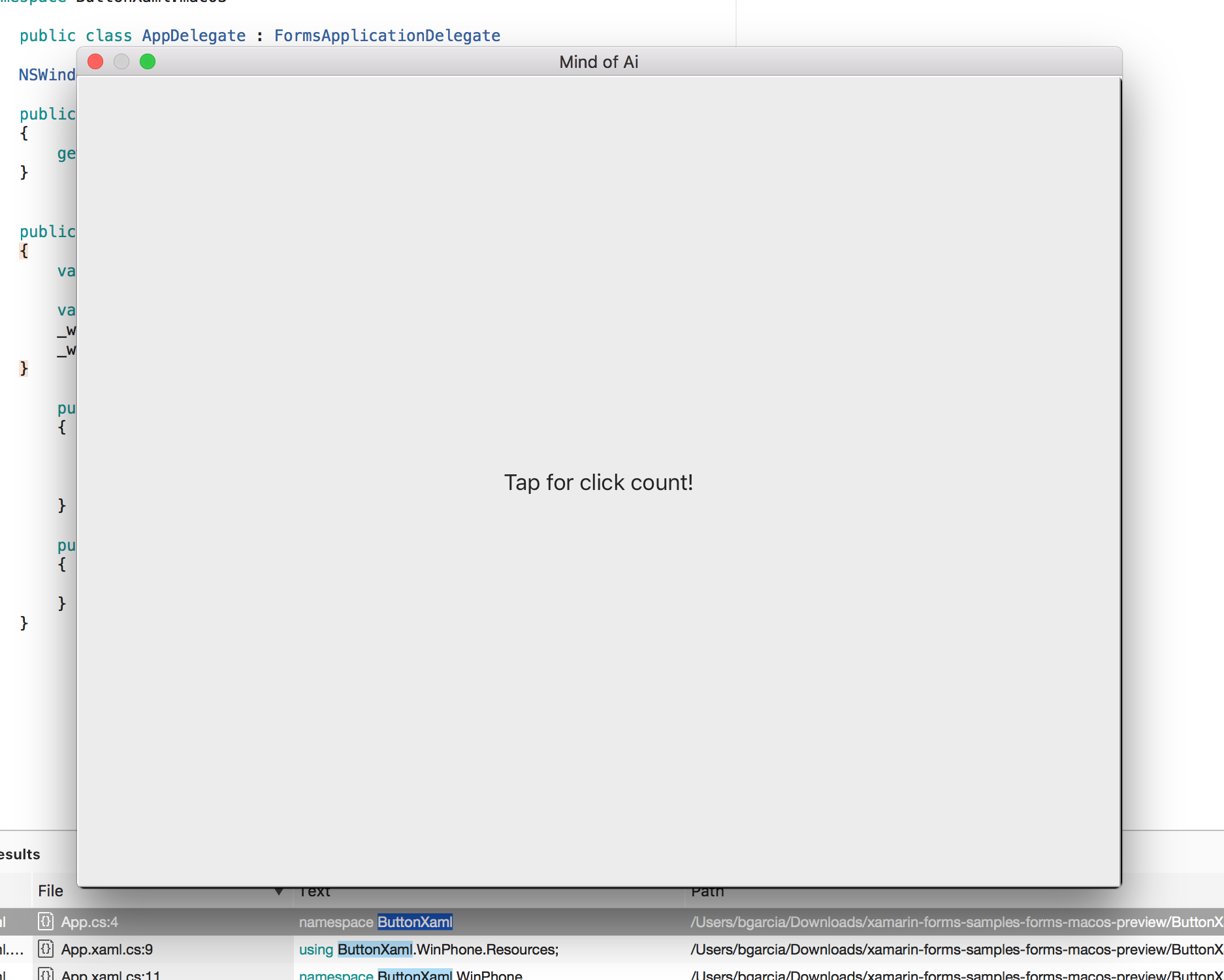
Add a Cocoa App Project. Until Xamarin.Forms templates adds a Cocoa App, we can easily add it ourselves. To do that in Xamarin.Studio or Visual Studio for Mac, add a new project to the solution and choose Mac > App > Cocoa App. Configure the Project. The Cocoa App template is configured with a storyboard implementation, which you won’t need. Using the familiar Visual Studio IDE, you can now develop applications by installing the extension Visual Studio Tools for Tizen, and use Xamarin.Forms as the UI framework. This new way of developing applications is a great opportunity, not only for existing Tizen developers, but for all Xamarin developers. Next, you'll need to create a new Visual Studio Mac extension that is an SDK style project and references the NuGet MonoDevelop.Addins v0.4.4. I've found that the Xamarin.Forms bootstrapping process does not work in Visual Studio Mac extensions that are not SDK style projects.
I am fully aware similar questions have been asked (and answered) However, nothing has worked for my particular case. The issue occurs in Visual Studio for Mac when trying to create a new Xamarin Forms Blank project. As soon as the project is created there are already errors:
Could not install package 'Xamarin.Android.Support.v4 23.3.0'. You are trying to install this package into a project that targets 'MonoAndroid,Version=v2.3', but the package does not contain any assembly references or content files that are compatible with that framework. For more information, contact the package author.
From the solutions I have read, people have said I must have the same Target Android/API and Target Framework version. Ive tried with several versions of android, however VS wont allow me to edit the Target Framework:
Ive so I set the Target Android version to be Android 7.1 (API 25)
Also it seems that the packages folder under the Xamarin Droid project is empty, so i try to install the NuGet packages needed
Xamarin.Android.Support.v7.AppCompat
And the same errors occur. This is frustrating because I cant even start to develop or test my code immediately out of the box Xamarin/VS has issues.
If anybody knows how to help, please be very specific, everything else online has been very vague, 'need to update Xamarin.Forms' or something without much detail or procedural explanation. I know many many others are having similar issues with VS/Xamarin on MacOS. Here is my package structure:
Thanks in advance.
3 Answers
I was struggling with this too.
The root cause was that I had no Android SDK accessible to my user, so there was no target platform to choose and no nuget packages were installed.
I ended up doing the following:
- Install Android Studio with all the defaults and install a few Android SDK levels with the Android Studio SDK manager.
- Get the SDK path from Android Studio and paste it into the Preferences/SDK Locations in Visual Studio.
- Restart Visual Studio and create a new project - it will install some nuget packages this time.
- Open the options for the Android project and choose suitable minimum and target Android versions under Android Application.
The project should build now.

When you install Visual Studio for Mac, there is a step to check to install Android SDK. You can check whether Android SDK is install or not in Visual Studio->Preferences->SDK Locations->Android
The step to install Android SDK is here. You need to select Android then check the Android SDK on the right side. Yes, its weird that it is not selected by default =.=:
Details guide of the installation can be refer https://lowleetak.wordpress.com/2017/07/01/xamarin-installation-in-mac/
lowleetaklowleetakApparently this is a known bug with VS for Mac:https://forums.xamarin.com/discussion/96085/could-not-add-packages
Not the answer you're looking for? Browse other questions tagged androidmacosvisual-studioxamarinandroid-appcompat or ask your own question.
Xamarin is a cross-platform technology that makes it possible to build native applications for Android and iOS using a single, shared codebase. Like other technologies such as React Native and NativeScript, it allows development teams to spend less time writing code for both platforms.
Xamarin is open-source (and free). Under the hood, it uses Mono (a version of the Microsoft .NET runtime), so Xamarin apps are usually written in C#. You can build Xamarin apps on Windows using Visual Studio, or Mac using Visual Studio for Mac. Even though Xamarin apps are not written in Swift (or Java), they still look and feel like real, native apps on the device.
In this tutorial, I’ll show you how to use Xamarin to build a basic app for both iOS and Android, even if you’ve never done any app development before!
Set Up Xamarin on Windows
Skip to the next section if you have a Mac!
If you don’t have Visual Studio installed, download the free Community Edition from Microsoft.
When you install Visual Studio, be sure to pick the Mobile development with .NET workload, which installs the Xamarin tools you need:
If Visual Studio is already installed, open the Visual Studio Installer to make sure you have the above workload selected.
Once you have these tools installed, you’re ready to create a Xamarin project! Skip the next section.
Set Up Xamarin on Mac
If you have a Mac, you’ll need to install Visual Studio for Mac. Follow the official instructions to install the free Community Edition.
Once the application is installed, you’re ready to create a Xamarin project!
Xamarin and Xamarin Forms
The base Xamarin SDK contains API bindings for each mobile platform, so you can call Android or iOS APIs from C# code. This allows you to build native apps using shared C# code, but you still need to design the UI separately for each platform.
Xamarin.Forms is an additional library that makes it possible to build your UI once (in XAML, a markup language for describing UI layouts). Xamarin.Forms then does the hard work of translating your XAML layout into the appropriate UI elements on the target platform. You can drop down to the “lower” Xamarin SDK level and interact with the platform APIs whenever you need to.
Deciding whether to use Xamarin.Forms in your project depends on how complex your app is. If you’re building an app that needs UI ultra-tailored for each platform or includes a lot of complex user interactions (such as a game), you’re better off with base Xamarin.
However, if you’re building a straightforward app that doesn’t need much platform-specific functionality or custom UI, using Xamarin.Forms means you can write even less code. Data-entry apps, productivity tools, and prototypes are great candidates. Since the goal of this tutorial is building a simple demo app, you’ll use Xamarin.Forms here!

Create a New Xamarin.Forms Project
In Visual Studio, choose File - New Project, pick the Cross-Platform category, and choose the Cross-Platform App (Xamarin.Forms) template. Name the project HelloWorldApp.
Then, pick the Blank App template and the platforms you want to build the app for. Choose Xamarin.Forms as the UI Technology, and .NET Standard as the Code Sharing Strategy:
In Visual Studio for Mac, choose File - New Solution, pick the Multiplatform - App category, and choose the Blank Forms App template:
Creating the new project may take a few minutes. The Blank App template creates a solution with a few sub-projects:
- HelloWorldApp: Contains the XAML and shared code for each platform-specific project.
- HelloWorldApp.Android (or Droid): Android-specific code. For a simple project, you won’t have to change much here.
- HelloWorldApp.iOS: iOS-specific code. You won’t have to change much here, either.
If you picked Windows (UWP) as a platform, your solution will contain an additional project targeting Windows devices.
In this tutorial, you’ll only need to modify the shared code project: HelloWorldApp.
Database Project In Visual Studio
Add a Page
UI views are called “pages” in Xamarin.Forms lingo, and your app already contains one called MainPage (or HelloWorldAppPage in Visual Studio for Mac). Double-click the XAML file in the Solution Explorer, and replace everything within the <ContentPage> tags with this markup:
This XAML markup creates a basic layout containing Label, Entry (text box), and Button elements. The element names (specified with x:Name) will be used to refer to these elements later in code. These XAML elements are generic and aren’t yet tied to a specific platform. Xamarin.Forms will automatically translate the elements in proper UIButton or EditText views when your app runs on iOS or Android.
The Clicked attribute on the Button element wires up the button click event to a handler called SayHelloButtonClicked, which doesn’t exist yet. You’ll write that next.
Add Code to the Page
Xamarin Visual Studio 2015 Download
Each XAML file is paired with a C# code file, sometimes called a “code-behind”. Open up the code for the MainPage.xaml (or HelloWorldAppPage.xaml) file by expanding it in the Solution Explorer and selecting the MainPage.xaml.cs file.
Below the public MainPage() method, add the new SayHelloButtonClicked method:
You may need to add the following declaration at the top of the file:
Because it’s referenced in the Clicked attribute, this method will run when the button is pressed or tapped on the XAML page. First, the value of the textbox is assigned to the name variable, and then the DisplayAlert method is called to display a modal alert on the device.
That’s it! Your new Xamarin app is ready to go. To test it, you can use a simulator, or you can use Xamarin Live Player to test it on a live device.
Test Your Xamarin App on Your Own Device
The quickest (and coolest) way to test a Xamarin project is with Xamarin Live Player, a small app you can download onto your own phone or device. After downloading the app, pair it with Visual Studio. Then, pick Live Player as the device target.
Start debugging by pressing the play icon, or choose Run - Start Debugging on the Mac. You’ll be asked to scan a QR code to pair Visual Studio with your device, and Live Player will connect to your computer. (If it hangs, make sure your computer and your device are on the same wi-fi network).
After Live Player connects, you’ll be able to immediately start using your app on your device! You can even make changes to the code in Visual Studio and Live Player will refresh the app on your device automatically. Super cool.
Test Your Xamarin App on Android
If you have the Visual Studio Android Emulator installed, testing the Android version of your Xamarin app is simple. In the Visual Studio toolbar, pick the HelloWorldApp.Android project and choose an Android device to emulate. Then, click the play button to start the emulator.
The Android emulator can be slow to load, so give it some time. If everything builds properly, you’ll see your app running on Android:
Test Your Xamarin App on iOS
Testing your Xamarin app on iOS is a little trickier, because it requires a Mac to provide the simulator. (Unless you’re already on a Mac and using Visual Studio for Mac, in which case, you’re good to go!)
If you’re on Windows and have a Mac handy, follow the official instructions to set up the Mac agent and connect it to Visual Studio. Then, pick the HelloWorld.iOS project, and switch the architecture to iPhone Simulator. Choose a device version and click play.
After the project builds, the simulator will launch on the Mac:
Next Steps
This tutorial only scratches the surface. There’s a ton more you can do with Xamarin!
How To Create A Project In Visual Studio
Here’s some further reading:
Xamarin.Forms samples apps and code on GitHub
Developing Enterprise Apps using Xamarin.Forms and the accompanying free eBook
Visual Studio With Xamarin
Do you want to learn more about Xamarin? What about other cross-platform app stacks like React Native, NativeScript, or Flutter? Let me know in the comments below!