Mikayla Hutchinson introduces Visual Studio for Mac, outlining the evolution of the Xamarin Studio IDE into a true mobile-first, cloud-first development tool for.NET and C# that brings the Visual Studio experience to the Mac. I'm starting a new project using Visual Studio 2017 Community for Mac. I've already set up a GitLab repo for the project, but I can't for the life of me figure out how to connect VS Mac to the rep.
-->Subversion is a centralized version control system, meaning that there's a single server that contains all files and revisions, from which users can check out any version of any file. When files are checked out from a remote Subversion repository, the user gets a snapshot of the repository at that point in time.

To use Subversion for your version control, it must be installed on your machine. To check if Subversion is installed your machine, use the following command in Terminal:
This command returns the version number.
If Subversion isn't already installed, the easiest way to get it is by installing the Xcode Command Line Tools. Use the command below to install Xcode Command Line Tools and Subversion.
Once Subversion is installed on your machine, use the following steps to publish your project in SVN.

Create a free SVN repository online. For this example, Assembla was used. Once created, a URL will be provided, which will be used to connect to the repository:
Open or create a Visual Studio for Mac Project.
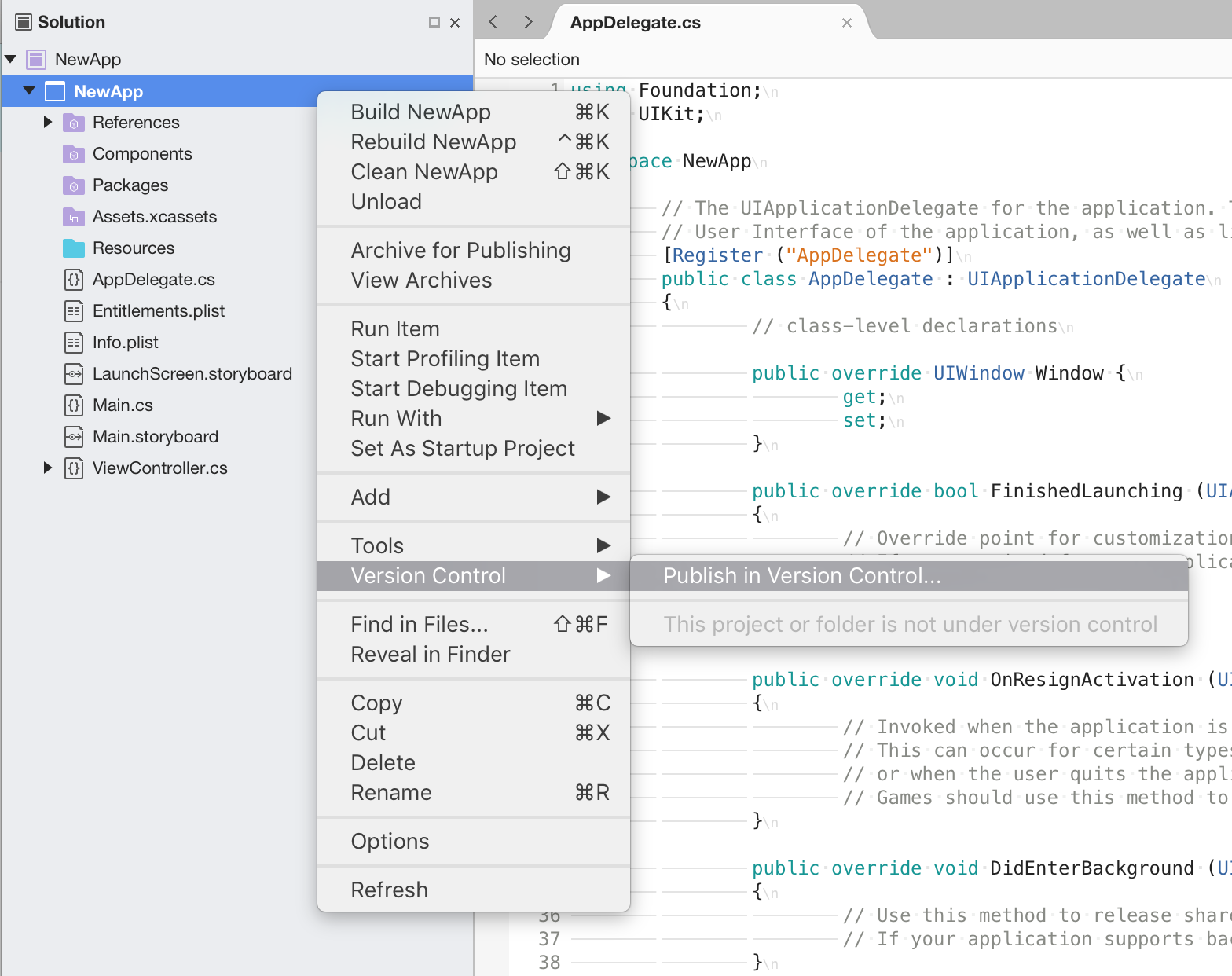
Right click on the Project and select Version Control > Publish in Version Control...:
In the Connect to Repository tab, select Subversion from the top drop-down.
Enter the URL from step 1. Once the URL is entered, the other fields are populated by default:
Click OK and then confirm by pressing Publish.
If prompted, enter your credentials for the site on which you create the repository, as illustrated below:
All the version control commands available should now be visible in the version control menu.
See also
Visual Studio for Mac was released just under two months ago at Build 2017, and already we’ve seen tremendous growth in .NET developers working on the Mac. Visual Studio for Mac enables you to build native apps for macOS, native mobile apps for iOS, tvOS, watchOS, and Android, using Xamarin and Xamarin.Forms; and web sites and services using ASP.NET Core. You can also use Unity to build cross-platform 3D games.
To help new Visual Studio for Mac developers get started, we’ve created some hands-on labs to walk through some of its exciting new features. The first two labs are available today, for Unity game development and connecting to Internet of Things (IoT) devices, and we’re planning to release 4 more in the coming weeks.
Lab 1: Building Games with Unity in Visual Studio for Mac
The first hands-on lab demonstrates how to build and debug Unity game projects. It guides you through 4 tasks:
- Setting up a basic Unity project
- Working with a 3D game scene
- Debugging the game script
- Exploring additional features that support game development.
Follow these instructions to download and install Unity, then use it with Visual Studio for Mac to script and debug a 3D game scene.
Lab 2: Targeting IoT Devices in Visual Studio for Mac
Writing Css In Visual Studio For Html Website
Our second lab shows you how to create apps that run on an IoT device – such as the popular Raspberry Pi – from Visual Studio for Mac. It guides you through 3 tasks:
Connect To A Repository In Visual Studio For Mac
- Setting up your Raspberry Pi
- Creating the IoT project
- Extending your IoT app with Xamarin components to add additional features.
This functionality is currently in preview, but we’ll make sure to update the lab if any changes will be necessary when we ship it in a stable release.
Follow these instructions to write your first IoT code, then visit our IoT samples for more ideas.
Get Started
Download Visual Studio for Mac today, and visit our labs repo on GitHub to give game development a try or connect to an IoT device. With the Community Edition it is easy and free to get started. Keep an eye on this blog for more labs that demonstrate all the other great features of Visual Studio for Mac.
| Craig Dunn, Principal Program Manager @conceptdevCraig works on the Mobile Developer Tools documentation team, where he enjoys writing cross-platform code for iOS, Android, Mac, and Windows platforms with Visual Studio and Xamarin. |